
Blackjack Strategy Charts: What This Page Covers
This page focuses on easy-to-use strategy charts and how to apply them to real and online blackjack tables. It does not re-teach the rules of the game, where to play, card counting systems, or full 6:5 analysis; those live on the dedicated blackjack guides, simulators, and subpages.
Instead, this is the home base for players who want a clear chart, simple rules for using it, and a system for remembering the key decisions when the casino noise kicks in.
You will find:
- Strategy chart reading guide
- Hard/soft hands, split aces, surrender breakdowns
- Dealer hits soft 17 adjustments
- Blackjack basic strategy memory system
How to Read Blackjack Strategy Charts
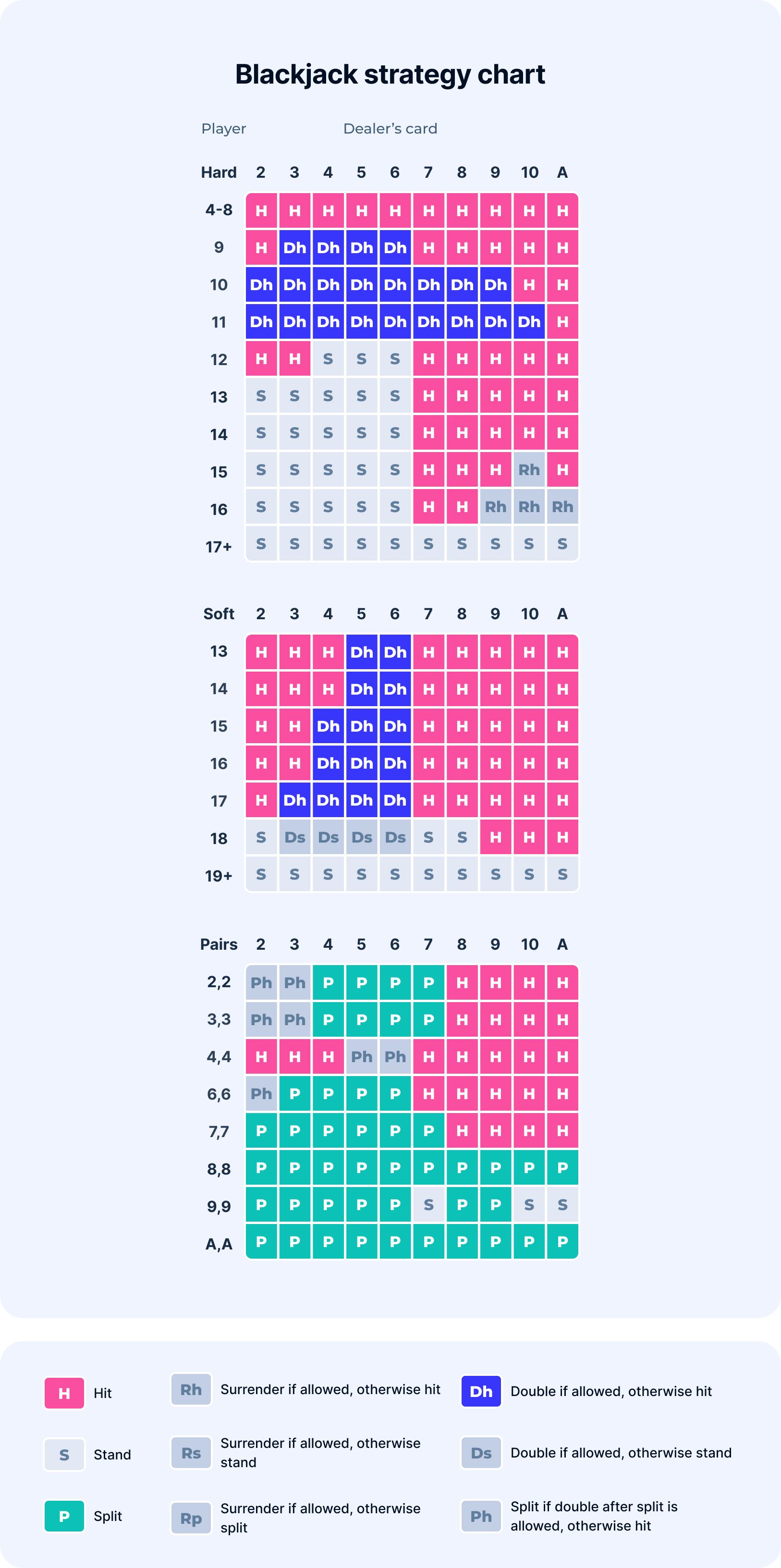
A blackjack strategy chart is a colour-coded grid showing the mathematically best move for every combination of your hand vs dealer upcard under standard rules. Charts here assume multi-deck blackjack games with 3:2 payouts, and dealer stands on soft 17, delivering basic blackjack strategy's maximum edge.
Three main sections:
- Hard hands (no Ace counted as 11): 10 + 6 = hard 16
- Soft hands (Ace = 11): A + 7 = soft 18
- Pairs: First two cards matching rank
How to use: Find your initial hand down the left side, dealer's upcard across the top. Intersection square = your play (hit or stand, double, split pairs, surrender).
Priority order: Surrender first → split aces/pairs → double → hit or stand last. Pairs override totals. Never take out insurance.

Opinion of Andrew Collins
“Charts = rocket booster for casual players. House edge drops instantly. Gut plays feed casinos.”
Quick examples:
- Hard 16 vs dealer 10: Hit (counterintuitive but correct)
- Soft 18 vs dealer 6: Double (ace valued safety net)
- Pair of 8s: Always split pairs (escape 16 hell)
Legend: What the Chart Colours and Codes Mean
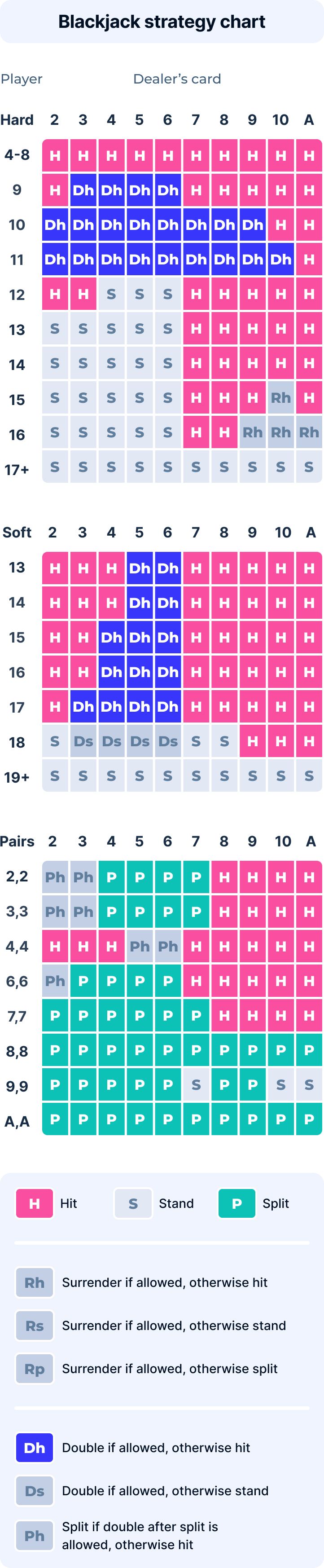
The legend turns visual blocks into precise instructions. Pink hit areas group together, grey stand blocks stand out, while doubles (blues) and splits (greens) grab attention instantly. Many players screenshot it zoomed for phone reference at live tables.
Priority order: Surrender (R*) first, split pairs (P*) (split aces always) second, double (D*) (ten valued cards vs weak dealer) third, hit/stand (H/S) last. Insurance bet? Never, auto-loser.
When a pair shows split, that takes priority over totals. Double decisions only apply where table rules allow. Colours keep decisions fast when casino pressure hits. The chart assumes multi-deck, 3:2 payouts, dealer stands on soft 17.
Many players screenshot this for casino or online blackjack. Use the blackjack chart legally, professional blackjack players all do.
Can Basic Blackjack Strategy Really Earn Us Money?
Hard hands (no ace valued as 11) are where casinos make most of their money from casual players, because small mistakes accumulate fast. The strategy built into the chart takes into account bust probabilities, dealer outcomes, and the fact that you see the dealer’s upcard.
As a rule of thumb, totals of 17 and above are almost always stands, whatever the dealer shows. That may mean standing on an ugly hard 17 versus a dealer 10, but taking a hit there usually costs more in the long run than riding out the hand. Totals of 11 and lower are generally hits because you cannot bust with a single card and have good chances to improve.
The tricky band is 12 to 16. Here, the basic strategy often recommends standing against the dealer 2 through 6 and hitting against 7 through Ace. That counterintuitive line comes from the dealer’s bust risk. When the dealer shows a weak card, such as 4, 5, or 6, letting them draw and potentially bust is more profitable than risking your own bust with another card.
You will also notice that some hard hands become doubles against specific upcards. A hard 10 versus a dealer 9, for example, is usually a double, because the combination of your strong total and their relatively weak card creates a profitable spot. The chart breaks all that into a simple instruction so you do not have to calculate it in real time.
Hard totals quick reference, stand 17+, hit 11-:
Opinion of Andrew Collins
“Hard 16 vs 10? Charts say hit. Feels suicide, wins long-term. Casinos love fear.”


How to play
Soft hand strategy: using the Ace properly
Soft hands allow more aggression because the Ace can fall back from 11 to 1 and keep you alive. Many newcomers misplay soft hands by treating them as fixed totals, but basic strategy charts squeeze extra value from this flexibility.
Soft 13 to 17 against a dealer 5 or 6 is often a double. The logic is simple: the dealer is under pressure with a weak upcard, and you can take a hit without fear of immediately busting. Doubling here uses your Ace as a safety net while you press the advantage. Dealer hits soft 17? Hit more aggressively.
Soft 18 is one of the most misplayed hands at the table. Against dealer 2, 7, or 8, standing is correct. Against 3 to 6, doubling is usually recommended. Against 9, 10, or Ace, hitting is often better, because soft 18 is not strong enough to stand pat against a dealer likely to reach 19 or 20. The soft section of the chart makes these subtle shifts very clear the moment you match your hand to the dealer’s card.
In short, if your hand includes an Ace that can still count as 11, treat it as a hand you can afford to push harder with when the dealer looks weak. The chart does the heavy lifting by showing when that aggression adds value and when it becomes an overreach.
Soft totals key plays:
Pair Strategy: When to Split and When to Hold
The pairs section of the chart is the antidote to the two biggest emotional mistakes: splitting 10s because “two winning hands are better than one”, and refusing to split 8s because “16 is already bad enough”. The math paints a different picture.
Split aces and 8s always; the first two cards matching give separate hands, regardless of what the dealer shows. Splitting Aces gives you two powerful starting hands with a strong chance of making 21 or close to it. Splitting 8s turns a horrible total of 16 into two hands starting from a modest but improvable 8, which overall loses less money than standing or hitting on 16.
Tens, including picture cards, should almost never be split. A total of 20 is already one of the strongest possible hands, and breaking it into two weaker hands to chase a big win swings the edge straight back to the house. The chart shows solid blocks of stand decisions across the row for tens, reinforcing that you should leave a good hand alone.
Other pairs depend heavily on the dealer's upcard. Small pairs like 2s and 3s are usually split against weak dealer cards, while mid pairs such as 6s and 7s are split only against specific ranges. When the chart shows a split, it is because creating two medium-strength hands yields a better expectation than playing one hand straight.
Split decisions, split aces/8s always:
Opinion of Andrew Collins
“Never split 10s. That 20 beats dealer 19 every time. Emotional splits = baited hooks.”
Using Surrender Correctly
Not every casino offers surrender, and some only allow it on certain hands. Where it is available, surrender is one of the most powerful tools in basic strategy, because giving up half the bet on terrible hands can save serious money over time.
Surrender 15/16 vs 9/10/Ace saves half the initial bet on doomed blackjack hands. Many casinos offer late surrender: check felt. Most blackjack games restrict re-splitting. These are hands where the combination of your weak total and the dealer’s strong upcard makes continuing with the hand worse than taking a controlled half-loss.
If surrender is not allowed, the chart falls back to the next best play, usually a hit. That is why reading the legend correctly and knowing your table’s rules matters. When you sit down, check the felt or rule plaque to confirm whether surrender is on the menu, then follow the surrender rows on the chart accordingly.
How Different Rule Sets Change Ctrategy
Basic strategy charts are built for specific rules, and small changes at the table can shift some squares in the grid. Knowing the main rule variations helps you choose the right chart and make the right adjustments.
Dealer hits soft 17 (H17)
When the dealer hits on soft 17 (H17) rather than standing (S17), the dealer wins a little more often. To counter this, the basic strategy recommends a few more aggressive plays, such as doubling certain soft hands versus dealer 6, or hitting in marginal stand spots. The core of the chart stays the same, but a handful of decisions flip.
Hit more, double extras on softs, e.g., double 11 vs A, soft 18 vs 2-6.
*Assumes DAS (double after split); if not allowed, revert doubles to hits.
Deck count and payouts
The number of decks also matters. Single-deck games, where only one deck is in play and cards are often dealt further before shuffling, favour the player slightly when played perfectly. Because of that, some borderline hands shift towards standing or doubling more aggressively. Many “single deck” tables now pay 6:5 for naturals, which damages the player’s edge so heavily that even perfect strategy cannot fully rescue it. This page assumes fair 3:2 games, with only a light reminder that full 6:5 analysis lives on the dedicated payout page.
European no-hole rules
European no-hole-card rules, common in some regions, mean the dealer does not check for blackjack until after all players act. This changes how risky it is to double or split against a dealer Ace or 10, because losing extra bets to an unseen blackjack becomes more likely. Charts designed for those rules usually show fewer doubles and splits in those spots, and this guide signposts which adjustments to make when you play under European procedures.
Additional rules barely shift blackjack basic strategy, with a slight edge gain. Practice: with our simulator. Advanced: see our card counting guide.
Practising with the Chart Until it Feels Natural
A chart only earns its keep when it moves from the page into memory and instinct. The easiest way to practise is to combine the chart with a free blackjack simulator. Load the rules that match the main chart, then play at a relaxed pace with the chart open beside the screen.
Start with hard hands first. For a week, focus on getting that part of the chart perfect, pausing every hand to trace along the grid until the move becomes obvious. Then repeat the process with soft hands, followed by pairs, and finally, surrender decisions. Breaking practice into these segments stops the chart from feeling overwhelming and makes retention far easier.
Once you feel comfortable, cover the chart and try to play a short session from memory. After each hand, uncover the chart and check your decision. Any hand you get wrong goes on a short list of “problem spots” to revise. Over a few sessions, those problem hands become automatic, and your overall play tightens up.
Simulator
Simple Memory Phrases That Capture the Chart
Even serious players do not memorise every single square on a large strategy grid. Instead, they use a mix of pattern recognition and short rules of thumb. A small set of phrases can anchor the most important parts of the chart.
“Always split Aces and 8s” handles the most valuable pair decisions in the game. “Never split tens” stops emotional misplays when big money is on the felt. “Double 11 against anything but an Ace” captures most of the powerful double situations for that hand without cluttering the mind.
“Soft 18 doubles against 3 to 6, stands against 2, 7, and 8, and hits against 9, 10, and Ace” summarises the complex soft 18 row in a way that can be rehearsed away from the table. “Surrender 16 versus 9, 10, or Ace when allowed” keeps the worst hard hands under control. Taken together, these short lines capture the heart of basic strategy even when you cannot look directly at the chart.
Using Strategy Charts in Live and Online Casinos
Most live casinos do not mind players referring to a printed or digital cheat sheet, as long as it does not slow the game or involve devices at tables where phones are restricted. Keeping a small laminated card in a pocket or a wallet, or a screenshot in a phone gallery, is usually acceptable; if in doubt, ask the dealer or floor host.
Online, charts become even easier to use. You can keep the page with the main chart open in another browser tab or on a second screen and flick your eye to it before each decision. Many serious players use short practice sessions before real-money play, using the online chart to check every move until they can play almost on autopilot.
Whether you are grinding low-stakes games at home or taking a seat in a noisy pit in Vegas, the principle stays the same. Choose a chart that matches the rules, follow it without second-guessing because of hunches, and let the maths do the work. Over time, correct decisions add up like accurate darts on a board; small edges that, hand after hand, keep you swimming calmly past the baited hooks.
Opinion of Andrew Collins
“Correct basic strategy = winning player. Charts beat 99% table play. Practice beats perfection.”
Best Blackjack Casinos
Blackjack Cheat Sheet FAQs
What does the main chart cover?
Multi-deck games with 3:2 payouts, dealer stands on soft 17. Use it for most UK and global tables. Single-deck or 6:5 needs tweaks, see subpages.
Hit or stand on hard 12 vs dealer 4?
Stand. Dealer busts 40%+ from weak cards. Hitting risks your own bust at higher cost.
Always split Aces and 8s?
Yes, every time. Aces give two strong starters. 8s escape the nightmare 16 total. Original bet doubles value.
When to double soft 18?
Against dealer 3-6. Ace flexibility lets you press weak upcards safely.
Surrender 16 vs dealer 10?
Yes, if allowed. Saves half your bet on a losing hand. Hit otherwise.
Can I use charts at live tables?
Yes, completely legal. printed sheet or phone screenshot is usually fine. Ask the dealer first.
European no-hole-card changes?
Fewer doubles vs Ace/10. Check rule-specific adjustments above.
House edge with perfect chart use?
0.5% standard rules. Casino's house edge crushed. Beating blackjack mathematically possible.