


What Are Roulette Odds?
Roulette odds explain how likely a roulette bet is to win and how much it pays if it does. Every wager on the roulette table corresponds to a specific number of possible outcomes on the wheel. The fewer numbers your bet covers, the lower your chance of winning - but the higher the payout. Conversely, bets that cover many numbers win more often but pay less.
For example, a single-number bet offers the biggest reward because it targets just one pocket on the wheel. Meanwhile, bets like red/black or odd/even cover nearly half of the numbers, giving you a much better chance of winning each spin but with smaller payouts.
Roulette odds are also influenced by the type of wheel used. European roulette has 37 pockets, while American roulette has 38 due to the additional double zero. That extra pocket slightly reduces your chances of winning and increases the casino’s advantage.
In short, roulette odds reveal the balance between risk and reward in the game. Understanding them helps you see which bets offer frequent wins, which offer bigger payouts, and how the mathematics behind the wheel shapes every spin.
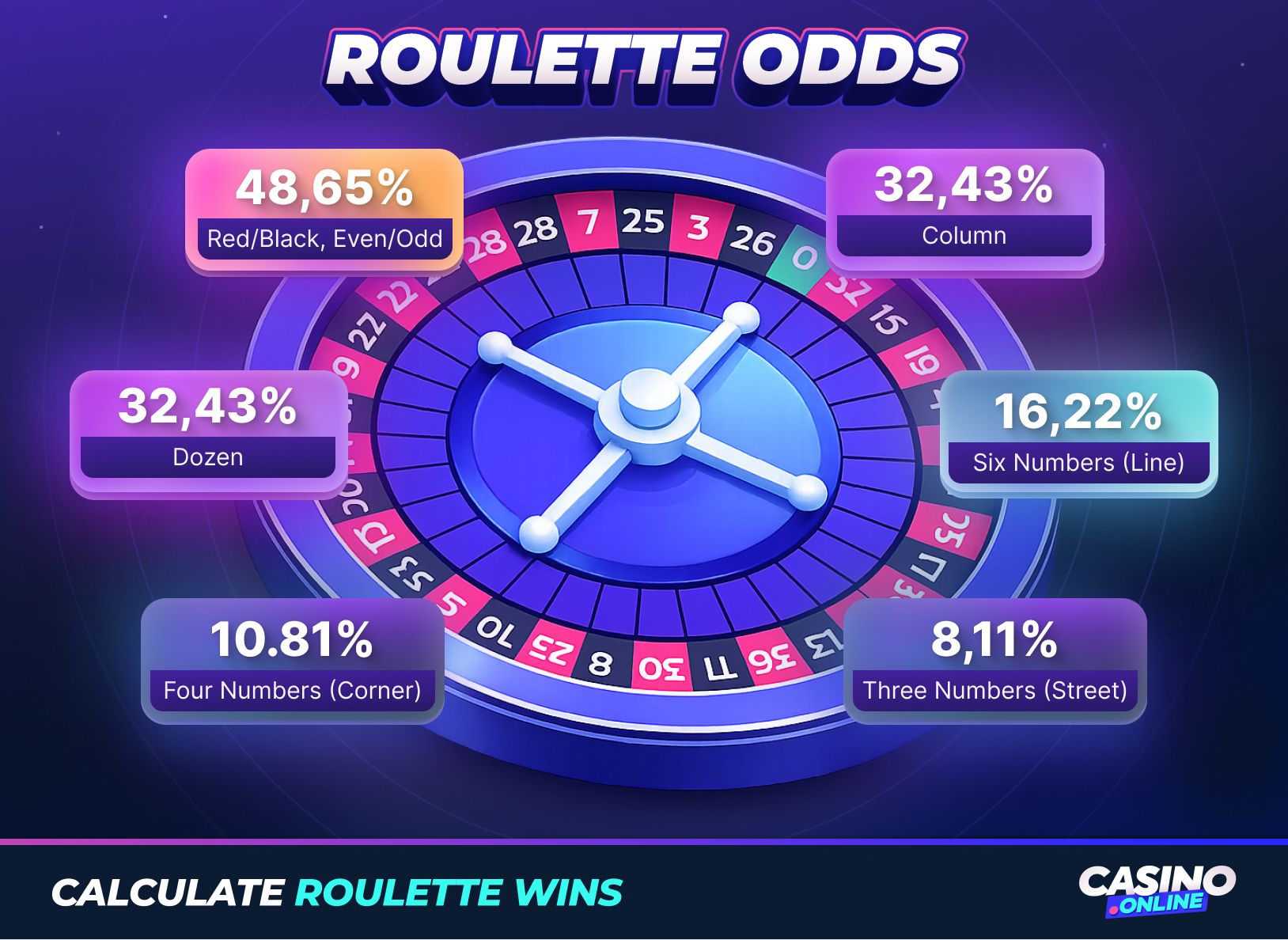
The Difference Between Probability of Winning and Payout Rate in Roulette
When players look at a roulette table, they often focus on the payouts - 35:1 for a single number, 17:1 for a split, or 1:1 for red or black. But to truly understand the game, it’s important to separate the probability of winning from the payout rate, because they are not the same thing.
Probability of winning refers to the mathematical chance that your bet will succeed on a given spin. It depends entirely on how many numbers your bet covers. For example, a straight bet on a single number in European roulette has a probability of 1 out of 37, while a red/black bet covers 18 numbers, giving it a much higher chance of winning.
Payout rate, on the other hand, determines how much the casino pays if your bet wins. The rarer the outcome, the higher the payout. That’s why a single-number bet pays 35:1, while red/black pays only 1:1.
The important detail is that roulette payouts are slightly lower than the true mathematical probability would suggest. If payouts perfectly matched the odds, a single-number bet in European roulette would pay 36:1 instead of 35:1. That small difference comes from the zero on the roulette wheel and exists on every bet - it creates the casino’s house edge, which is how the game remains profitable for the casino over time.
In short, probability tells you how likely a bet is to win, while payout rate tells you how much you receive if it does. The gap between the two is subtle, but it’s the mathematical foundation that keeps roulette both exciting for players and sustainable for casinos.
European vs American Roulette Odds
When playing roulette, the type of wheel you play on has a direct impact on your odds. The two most common versions - American and European roulette - use slightly different wheel layouts. That small difference changes the probability of winning and the casino’s advantage, which is why experienced players almost always prefer one version over the other.
European roulette odds explained
European roulette uses a wheel with 37 pockets: numbers 1-36 plus a single zero (0). Because there is only one green zero pocket, the probabilities for players are slightly more favorable.
For example, a single-number bet has a probability of 1 in 37 (2.70%), while even-money bets such as red/black, odd/even, or high/low win 18 out of 37 spins, or about 48.65% of the time.
Since payouts remain fixed, the mathematics of the wheel gives the casino a house edge of 2.7%. This is considered relatively low for casino games, which is why the European layout is often regarded as the best option for players looking for fairer odds.
American roulette odds explained
American roulette follows the same basic rules and payouts but includes one major difference: the wheel has 38 pockets instead of 37. Along with numbers 1-36 and a single zero (0), it also features a double zero (00).
That extra pocket may seem minor, but it significantly changes the probabilities. A single-number bet now has odds of 1 in 38 (2.63%), while even-money bets like red/black win 18 out of 38 spins, or 47.37%.
Because payouts are identical to those in European roulette, the additional pocket increases the casino’s mathematical advantage. As a result, American roulette has a house edge of 5.26%, nearly double that of the European version.
Why European roulette offers better odds
The reason European roulette offers better odds is simple: there is only one zero instead of two. With fewer losing pockets on the wheel, every bet has a slightly higher chance of winning.
While the difference may seem small during a single spin, it becomes significant over longer sessions. A 2.7% house edge instead of 5.26% means players lose money more slowly on average, giving them more playing time and better overall value.
For this reason, most professional guides - and many experienced players - recommend choosing European roulette whenever possible, especially when playing online where both versions are often available.
Types of Roulette Bets and Their Odds
Roulette is a game of choices. Every spin gives you dozens of betting options, each with its own balance of risk, probability, and payout. Some bets cover just one number and offer huge rewards if they land, while others spread across half the wheel and win far more often.
To understand how roulette works, it helps to divide bets into three main categories: inside bets, outside bets, and section (call) bets. Each category changes your chances of winning - and the potential payout you receive when the ball drops into the pocket.
What are the odds of inside bets
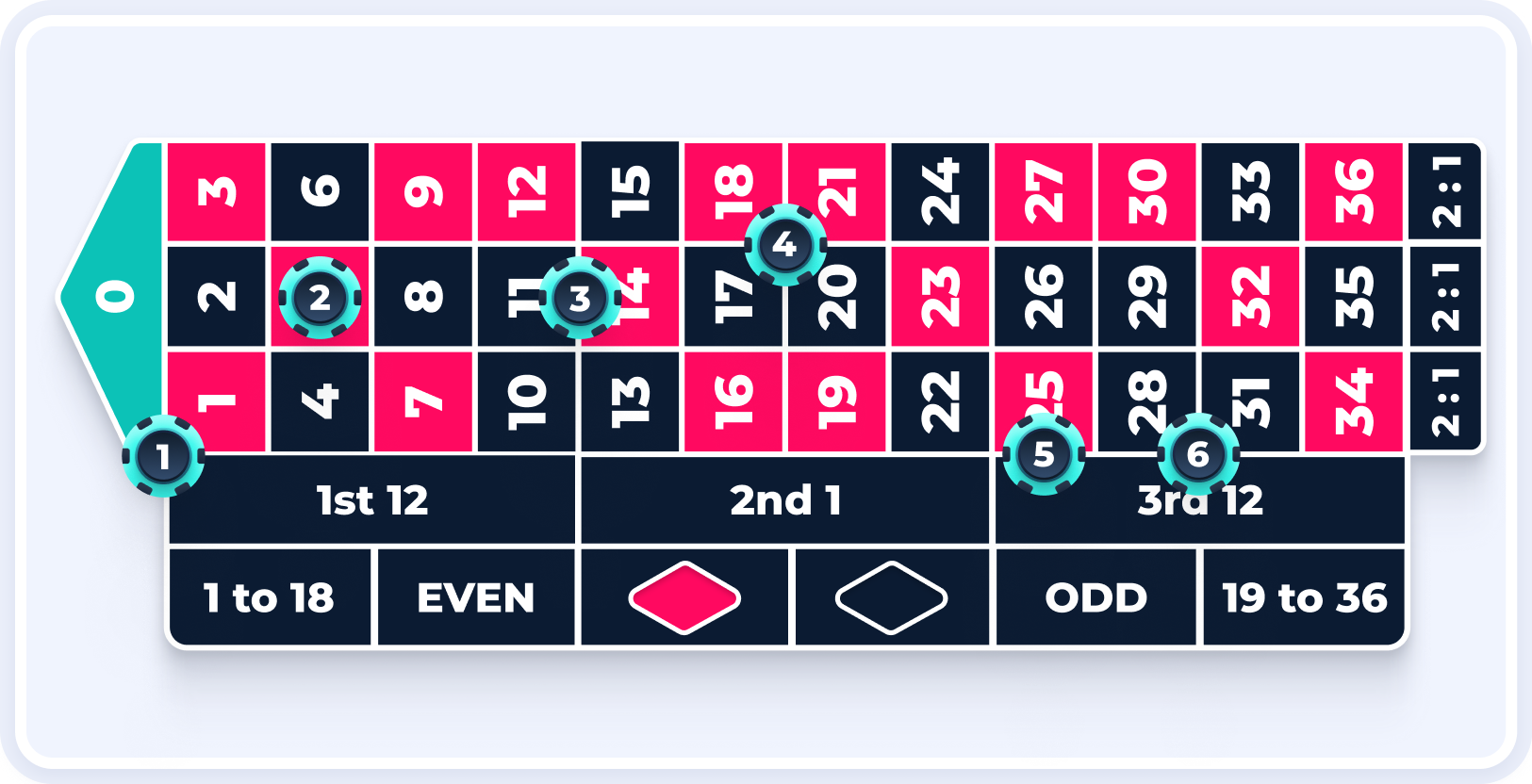
Inside bets are placed directly on the numbered grid in the center of the roulette table. These wagers focus on specific numbers or small clusters of numbers, which is why they offer the largest payouts in the game.
The trade-off is simple: the fewer numbers your bet covers, the lower the probability of winning. Inside bets are ideal for players chasing higher rewards or looking to target specific numbers.
Note: The basket bet is unique to American roulette because it involves both 0 and 00. It is considered one of the worst bets in roulette due to its very high house edge (7.89%), which is significantly higher than other bets on the table.
Inside bets create the most dramatic moments in roulette - hitting a straight-up number delivers the biggest payout on the table, which is why these wagers are a favorite for thrill-seekers.
What are the odds of outside bets
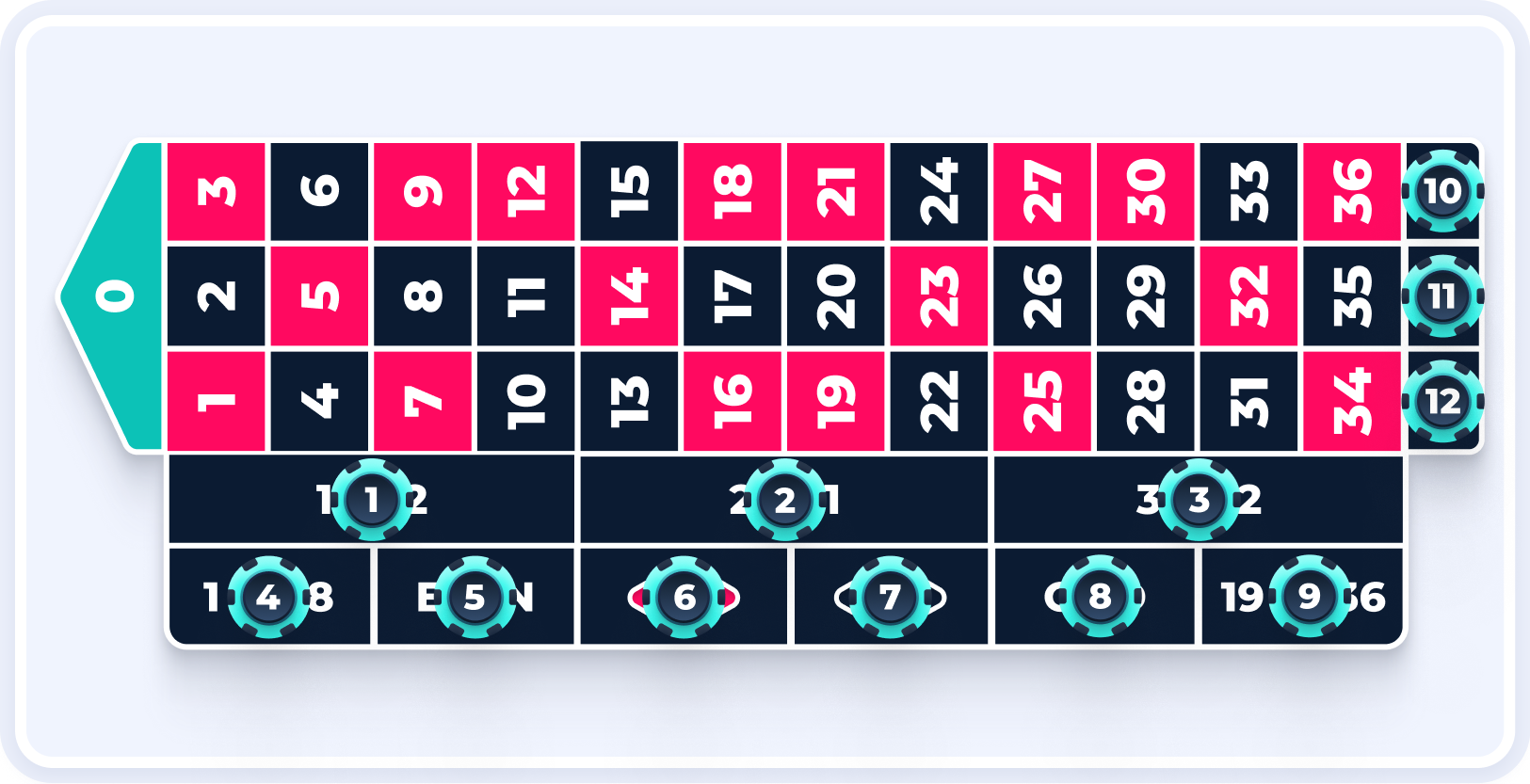
Outside bets sit around the outer edges of the table layout and cover much larger groups of numbers. Because they include many possible outcomes, they win far more often than inside bets, though the payouts are smaller.
These wagers are popular with beginners and cautious players because they provide more consistent wins and smaller bankroll swings.
Note: A 'column' bet gives you a choice of numbers grouped in one of the three columns stretching down the table, while a 'dozens' bet allows you a similar choice of three number groups, but this time stretching horizontally across the roulette table.
Even though such bets feel "safer," it’s worth remembering that the house edge remains the same for all bets on the same wheel. The difference lies in how often you win versus how much you win.
What are the odds of section bets
Beyond the standard inside and outside wagers, roulette also offers section bets, commonly known as call bets. These bets are especially popular in European and French roulette because they focus on specific sections of the wheel rather than the table layout.
When placing a section bet, the dealer automatically distributes your chips across multiple inside bets that together cover a defined part of the wheel. This allows players to target particular wheel segments instead of individual numbers.
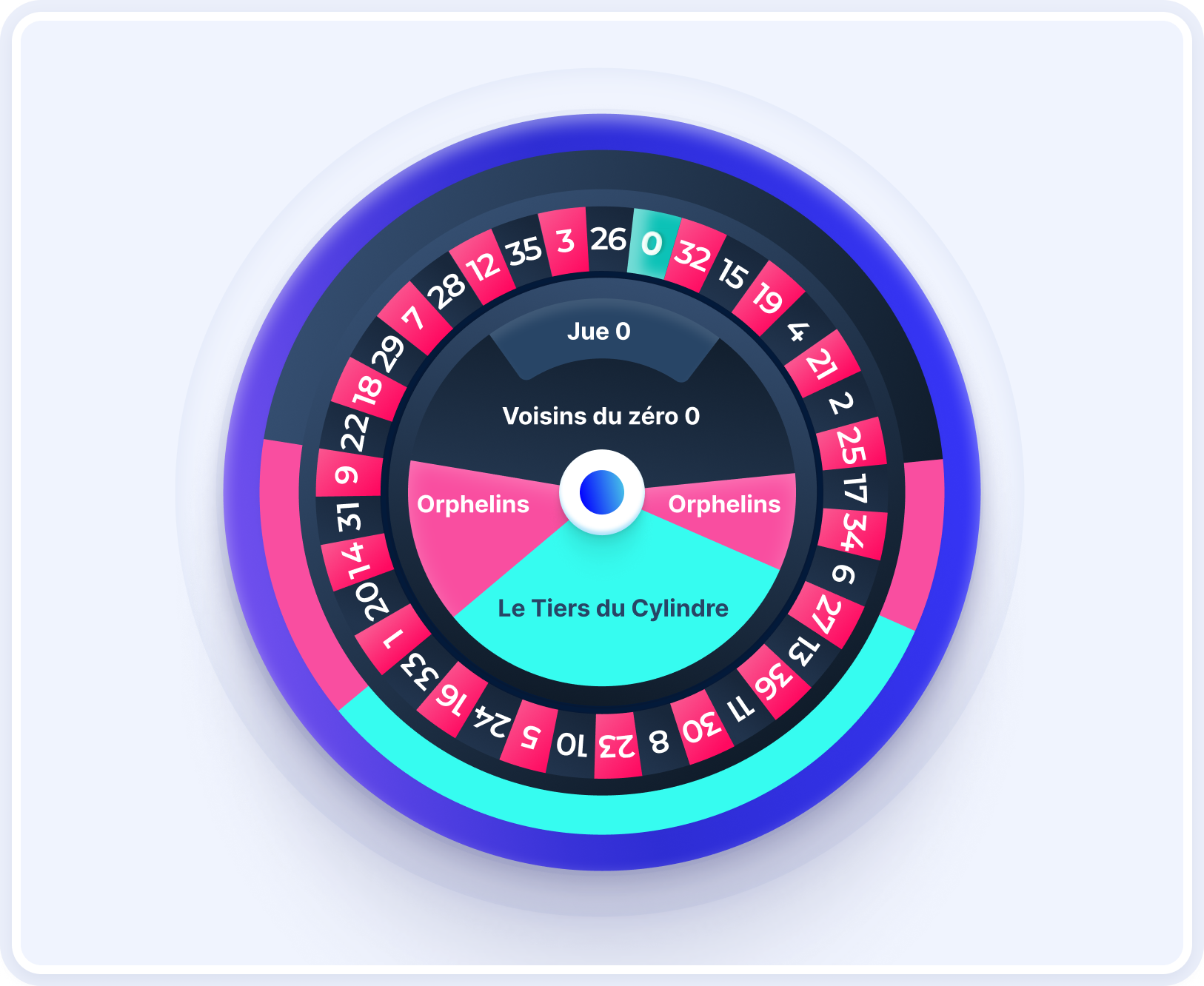
Voisins du Zéro
Voisins du Zéro (“neighbors of zero”) covers the largest portion of the wheel surrounding the zero pocket. It includes 17 numbers, making it one of the most comprehensive section bets in roulette. The wager is typically placed using nine chips spread across a combination of splits, corners, and straight bets.
Numbers covered:
22, 18, 29, 7, 28, 12, 35, 3, 26, 0, 32, 15, 19, 4, 21, 2, 25
Winning probability
- European roulette: 17 / 37 ≈ 45.95%
- American roulette: 17 / 38 ≈ 44.74%
Because this bet covers nearly half the wheel, it offers one of the highest hit frequencies among section bets, though payouts vary depending on which specific inside bet wins.
Tiers du Cylindre
Tiers du Cylindre (“third of the wheel”) covers 12 numbers located opposite the zero on the roulette wheel. The bet is usually placed with six split bets, each covering two adjacent numbers.
Numbers covered:
27, 13, 36, 11, 30, 8, 23, 10, 5, 24, 16, 33
Winning probability
- European roulette: 12 / 37 ≈ 32.43%
- American roulette: 12 / 38 ≈ 31.58%
This bet offers a balanced mix of probability and payout, making it a popular option for players who want moderate risk with potential mid-range returns.
Orphelins
Orphelins (“orphans”) covers the eight numbers not included in Voisins du Zéro or Tiers du Cylindre. These numbers are split across two small wheel segments and are usually played with five chips placed on split and straight bets.
Numbers covered:
1, 6, 9, 14, 17, 20, 31, 34
Winning probability
- European roulette: 8 / 37 ≈ 21.62%
- American roulette: 8 / 38 ≈ 21.05%
Because it targets a relatively small part of the wheel, Orphelins hits less frequently but can still deliver solid payouts depending on which number lands.
Jeu Zero
Jeu Zero (or Zero Game) focuses on the numbers closest to the zero pocket. This compact section bet covers seven numbers and is usually played with four chips placed on three splits and one straight bet.
Numbers covered:
12, 35, 3, 26, 0, 32, 15
Winning probability
- European roulette: 7 / 37 ≈ 18.92%
- American roulette: 7 / 38 ≈ 18.42%
Because the bet centers around the zero area of the wheel, it appeals to players who like to target spins that cluster near the green pocket.
Neighbor bets
Neighbor bets are flexible section bets where players choose a specific number and also cover the numbers immediately next to it on the wheel. The size of the bet depends on how many neighbors are included.
For example, a “5-neighbor bet on 17” covers 17 plus two numbers on each side of it, meaning five numbers in total.
Winning probability (5-number neighbor bet)
- European roulette: 5 / 37 ≈ 13.51%
- American roulette: 5 / 38 ≈ 13.16%
Neighbor bets are commonly used by players who follow wheel trends or hot zones, allowing them to focus their wagers on a specific area of the wheel rather than scattered numbers on the table.
Section bets add another layer of strategy and variety to roulette. Instead of betting purely on table positions, players can target physical segments of the wheel, which many enthusiasts believe creates a more intuitive and engaging way to play.
Practical Roulette Odds Examples
Roulette odds can feel abstract when you only see percentages on a chart. But once you translate those probabilities into real gameplay scenarios, it becomes much easier to understand what your chances actually look like during a session. Whether you’re betting on a single number, a color, or a dozen, each wager represents a specific slice of the roulette wheel - and that determines how often it can realistically win.
Below are some practical examples that show how roulette odds work in real situations.
Odds of hitting a single number
A straight-up bet on a single number is the most famous roulette wager - and the most dramatic. You pick one exact number on the table, such as 17, and win if the roulette ball lands exactly on that pocket.
On a European roulette wheel, there are 37 pockets (1-36 plus 0). That means your chance of winning is 1 in 37, or about 2.70%. On an American wheel, which includes 0 and 00, the chance drops slightly to 1 in 38 (2.63%).
Example:
You place $10 on number 17.
- If 17 hits, you win 35:1, meaning $350 in profit plus your $10 stake back.
- If any other number lands, the bet loses.
Because the probability is so low, hitting a straight-up number is rare - but that’s exactly why the payout is so large.
Odds of winning even-money bets
Even-money bets are the most common roulette wagers. These include red or black, odd or even, and high or low (1-18 vs 19-36). Each of these bets covers 18 numbers on the wheel, giving them the highest probability of winning among standard bets.
- European roulette: 18 out of 37 numbers → 48.65% chance of winning
- American roulette: 18 out of 38 numbers → 47.37% chance of winning
Example:
You bet $20 on red.
- If the ball lands on any red number, you win $20 profit (1:1 payout).
- If it lands on black, zero, or double zero (American), the bet loses.
Even-money bets are popular because they hit almost half the time, making them a good choice for players who want steady gameplay rather than chasing big jackpots.
Odds of dozens and column bets
Dozens and column bets offer a middle ground between risk and reward. Instead of covering half the wheel like even-money bets, they cover 12 numbers, which is exactly one-third of the wheel. These bets pay 2:1, meaning you win double your stake.
Winning probability
- European roulette: 12 out of 37 numbers → 32.43% probability
- American roulette: 12 out of 38 numbers → 31.58% probability
Example scenario:
You place $20 on the second dozen (13-24).
- If the ball lands on any number from 13 to 24 → You win $40 profit.
- If it lands anywhere else → The bet loses.
Some players combine these bets for broader coverage. For instance, betting on two dozens at once covers 24 numbers, giving you roughly a 65% chance of winning on a European wheel, though the payout drops to even money when both bets are considered together.
These practical examples show the core idea behind roulette odds: the more numbers your bet covers, the higher your chances of winning - but the smaller the reward. Learning how these probabilities translate into real gameplay helps you make smarter choices every time the wheel spins.
Which Roulette Bets Have the Best Odds
Roulette is built on a simple idea: every bet trades probability for payout. The more numbers you cover, the more often you win - but the smaller the reward. Cover fewer numbers and the potential payout grows, but your chances of hitting the bet drop dramatically.
Because of this balance, some roulette bets are considered "safer", while others are known for their big payouts. Understanding how these bets compare can help you choose wagers that match your playing style and expectations at the table.
Safest roulette bets
The safest bets in roulette are the even-money outside bets, because they cover nearly half of the wheel. These include:
- Red / Black
- Odd / Even
- High (19-36) / Low (1-18)
Each of these bets covers 18 numbers, giving them the highest probability of winning among standard roulette wagers.
Winning probability
- European roulette: 18 / 37 = 48.65%
- American roulette: 18 / 38 = 47.37%
Example:
If you bet $20 on red, you win $20 profit if any red number appears. While the payout is modest (1:1), these bets hit almost half the time, making them popular with roulette novices and players who want smoother gameplay with fewer big swings.
Another relatively safe option is the dozen or column bet, which covers 12 numbers and wins about one-third of spins. These bets win less frequently than even-money wagers but offer higher payouts.
Highest-paying roulette bets
The bets with the highest payouts are the inside bets, which focus on specific numbers or very small groups of numbers within the table layout.
The most lucrative option is the straight-up bet, where a chip is placed on a single number. This bet pays 35:1, which is the largest payout available in standard roulette.
Other high-paying bets include:
- Split (2 numbers) - pays 17:1
- Street (3 numbers) - pays 11:1
- Corner (4 numbers) - pays 8:1
These bets create the biggest moments in roulette, but they win far less frequently because they cover only a tiny portion of the wheel.
Balancing risk & reward
Between the safest outside bets and the highest-paying inside bets lies a middle ground where players can balance probability and payout potential. Bets such as dozens and columns are often used for this purpose.
These wagers cover one-third of the wheel, offering a moderate chance of winning while still providing a meaningful payout of 2:1. The winning probability is about 32.43% in European roulette and 31.58% in American roulette.
In practical terms, these bets sit between the extremes: they offer better winning chances than most inside bets, while still delivering larger rewards than even-money wagers. For many players, this balance makes them a natural choice when trying to combine entertainment with a reasonable chance of success.
Ultimately, the "best roulette bet" depends on what you want from the game. Even-money bets offer the highest probability of winning, inside bets deliver the largest payouts, and dozens or columns provide a middle ground between risk and reward. Understanding how these options compare helps you approach the wheel with clearer expectations and a more confident strategy.
Want to see the specific numbers behind each wager? Use our free online roulette calculator to instantly check roulette odds and payouts, compare bets, and see how your chances change in different scenarios.
House Edge in Roulette
One of the reasons roulette has remained a casino favorite for centuries is its simplicity: a spinning wheel, a bouncing ball, and a range of bets that seem straightforward to understand. But behind that elegant design lies an important mathematical principle known as the house edge - the built-in advantage that allows casinos to profit over time.
In simple terms, the house edge is the percentage of every bet that the casino expects to keep in the long run. It doesn’t mean the casino wins every spin - players can and do win frequently - but over thousands of spins, the math ensures the casino maintains a consistent advantage.
Why the house edge exists
The house edge in roulette comes from the green zero pockets on the wheel. These pockets act as outcomes that cause most common bets - like red/black or odd/even - to lose. Because the payouts don’t fully reflect the true probabilities of the wheel, a small advantage always remains in favor of the casino. For example, betting on a single number in European roulette has a probability of 1 in 37, yet the game pays 35:1 instead of the mathematically fair 36:1. That slight difference is what creates the casino’s edge.
House edge in different roulette variants
The size of the house edge depends largely on the type of roulette wheel being used.
- European roulette: house edge of about 2.7%
- American roulette: higher house edge of about 5.26% due to the additional double-zero pocket
That difference may seem small, but it has a noticeable impact over time. On average, a $100 wagered in European roulette results in about $2.70 expected loss, while the same amount wagered in American roulette results in about $5.26 expected loss over the long run.
What the house edge means for players
The house edge doesn’t guarantee that the casino wins every spin. Roulette outcomes are random, and players can enjoy winning sessions and big payouts. However, over many rounds, the mathematical structure of the game ensures that the casino keeps a small percentage of all wagers. For players, understanding the house edge simply means knowing what to expect over time. Choosing games with a lower edge - such as European or French roulette - can help stretch your bankroll and improve the overall value of your play.
In the end, the house edge is what keeps roulette sustainable for casinos while still offering players a thrilling mix of chance, strategy, and suspense with every spin of the wheel.

Casino Games with the Lowest House Edge
You can find on this page:
Tips to Increase Your Winning Odds in Roulette
Roulette will always be a game of chance, but that doesn’t mean every approach is the same. Smart players focus on managing probability, choosing the right tables, and controlling their bankroll. While no roulette strategy can eliminate the house edge, the following tips can help you maximize your chances of success and extend your playing time.

Master the game before betting real money
Before you start wagering real money, take time to fully understand how roulette works. Learn the table layout, the different bet types, their payouts, and the odds behind each wager. Many online casinos offer free demo versions of roulette, which let you practice placing bets and following the game flow without risking your bankroll.
Choose European roulette whenever possible
Not all roulette wheels offer the same odds. European roulette has only one zero, giving the casino a 2.7% house edge, while American roulette adds a double zero, raising the edge to 5.26%. That small difference has a huge long-term impact. By simply choosing European roulette tables, you immediately improve your odds.
Stick to outside bets
If you want better winning chances per spin, outside bets are the safest place to start. These wagers - such as red/black, odd/even, and high/low - cover large portions of the wheel, which means they win far more often than inside bets. Although the payouts are smaller (usually 1:1), the higher probability can help stabilize your bankroll and keep you playing longer.
Take advantage of French roulette rules
Some roulette tables include special rules like La Partage or En Prison. These rules apply to even-money bets and return half your stake - or give you another chance - if the ball lands on zero. When available, these rules effectively reduce the house edge to about 1.35% (the lowest house edge in roulette), making them one of the best options for players.
Look for tables with favorable limits
Roulette tables often have different minimum and maximum bet limits. Choosing a table with limits that match your bankroll allows you to place initial bets comfortably without risking too much on a single spin. Lower minimum bets can also help stretch your session, so you can place more bets.
Manage your bankroll carefully
One of the most important skills in roulette isn’t betting strategy - it’s bankroll management. Decide in advance how much you’re willing to spend and divide that budget into smaller bets. Avoid placing large wagers too early, as smaller consistent bets can help you stay in the game longer and reduce the risk of quick losses.
Avoid chasing losses
Roulette outcomes are completely independent. Increasing your bets after a losing streak - often called 'chasing losses' - can quickly drain your bankroll. Even if a number hasn’t appeared for many spins, the probability of it hitting remains exactly the same. Staying disciplined protects your budget and keeps gameplay enjoyable.
Play roulette only at trustworthy casinos
Your roulette experience depends on the casino you choose. Always play at licensed platforms regulated by trusted authorities and committed to fair gaming standards. Reputable casinos use secure encryption, audited game software, and reliable payment systems, ensuring your data is protected and every spin is fair.
Roulette Odds FAQ
What are the best odds in roulette?
The best odds in roulette usually come from even-money bets such as red/black, odd/even, or high/low. These bets cover 18 numbers on the wheel and win about 48.65% of the time in European roulette. While the payout is only 1:1, they offer the highest probability of success per spin.
Which roulette variant offers the best odds?
European roulette generally offers the best odds for players. It uses a wheel with 37 pockets and only one zero, resulting in a house edge of about 2.7%. In comparison, American roulette includes an extra double zero, which nearly doubles the house edge.
Why isn't the probability of winning on red or black 50%?
Red and black bets cover 18 numbers each, but the wheel also includes green zero pockets that are not part of either color. When the ball lands on zero (or double zero in American roulette), these bets lose. This is why the true probability is slightly below 50%.
What are the odds on 0 and 00 in roulette?
On a European wheel, the probability of hitting the zero is 1 in 37 (about 2.70%). On an American wheel, the probability of hitting either 0 or 00 is 2 in 38 (about 5.26%) combined. These pockets are what create the casino’s house edge.
Can you beat the odds in roulette?
Roulette is designed with a built-in mathematical advantage for the casino, so beating the odds consistently is extremely difficult. Individual players can certainly place winning bets or hit large payouts, but over time the house edge ensures the casino maintains a long-term advantage.
Can a roulette betting system improve your odds?
Betting systems such as Martingale or Fibonacci can change how you manage your bets, but they do not change the actual odds of the game. The probabilities remain the same on every spin. These systems mainly affect bankroll management rather than the underlying mathematics.
Are there better odds in live roulette than in RNG roulette?
The odds are usually the same in live and RNG roulette as long as the wheel type is identical. A live European roulette table and an RNG European roulette game both follow the same probabilities. The difference lies in the experience, not the mathematical odds.
Are the odds of winning at online roulette fair?
At licensed online casinos, roulette games use certified RNG software or real live wheels, both regularly tested by independent auditors. This ensures the results are random and the probabilities match the theoretical odds of the game. As long as you play at reputable platforms, the odds are fair and transparent.
You can find answers to

